

Optimizing Forest Operations for Sustainable Forest Management and High-Value Applications
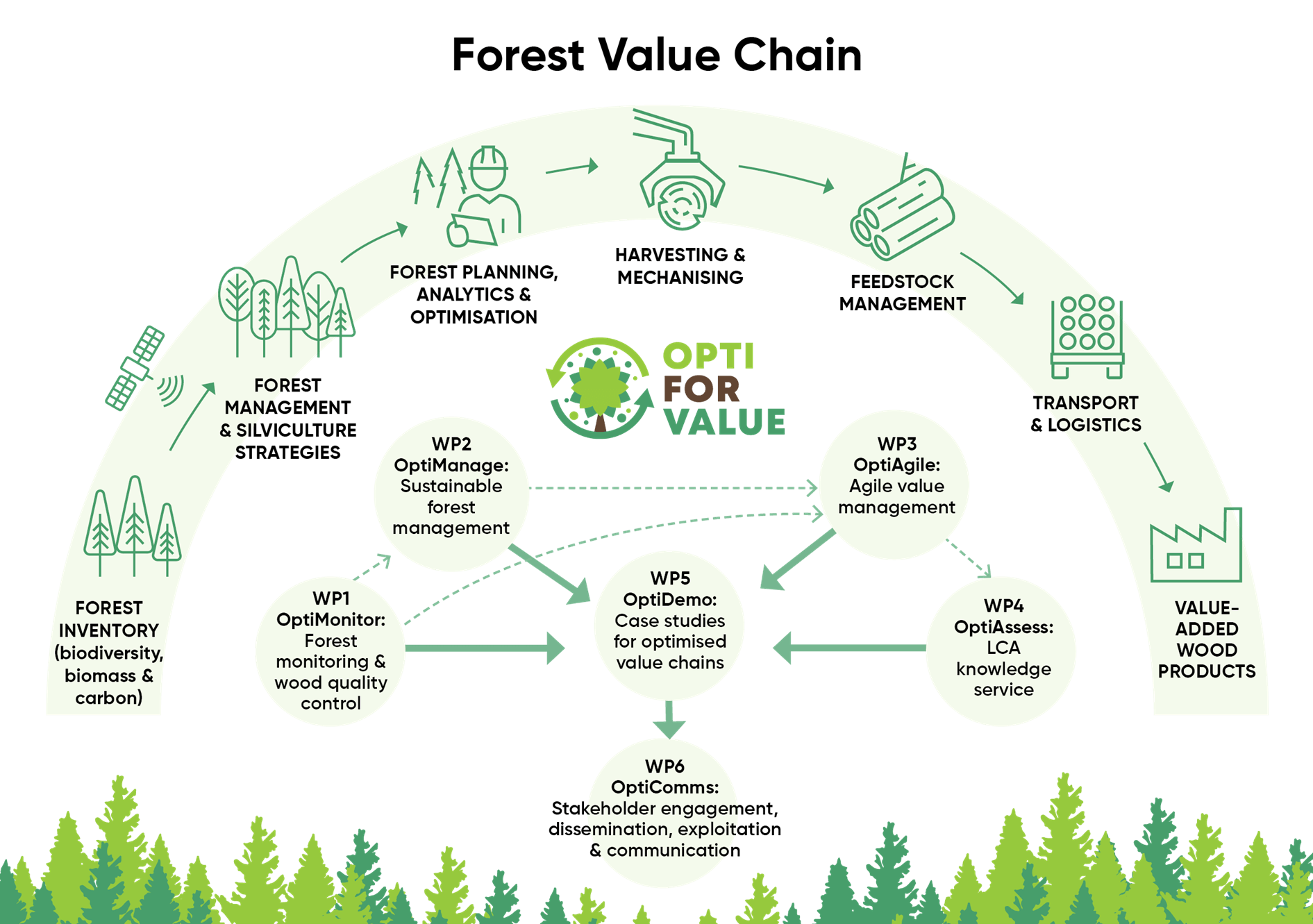
In a world where regulatory landscapes, trade, and environmental conditions are constantly evolving, value chains must be both robust and adaptable. OptiForValue addresses diverse challenges facing Europe’s forests, such as increasing global wood demand, biodiversity loss, and climate change threats (e.g., drought, fire, insects). The project’s overall goal is to enhance the value, sustainability, and resilience of forest-based value chains, and seeks to foster a transition to more sustainable and resilient value chains through enhanced forest management and optimization.
Project description
The project utilizes an interconnected modelling framework that combines insights about forest health and dynamics with large-scale environmental and structural impact. Enabled by strong participative engagement, modern modelling techniques and technologies can give a more complete view of forest management.
The project explores possible guidelines for the effective management of forest stands affected by damage and studies the effect of different regimes and conditions to establish more resilient regional value chains that improve supply security and increase, both economic and environmental, value.
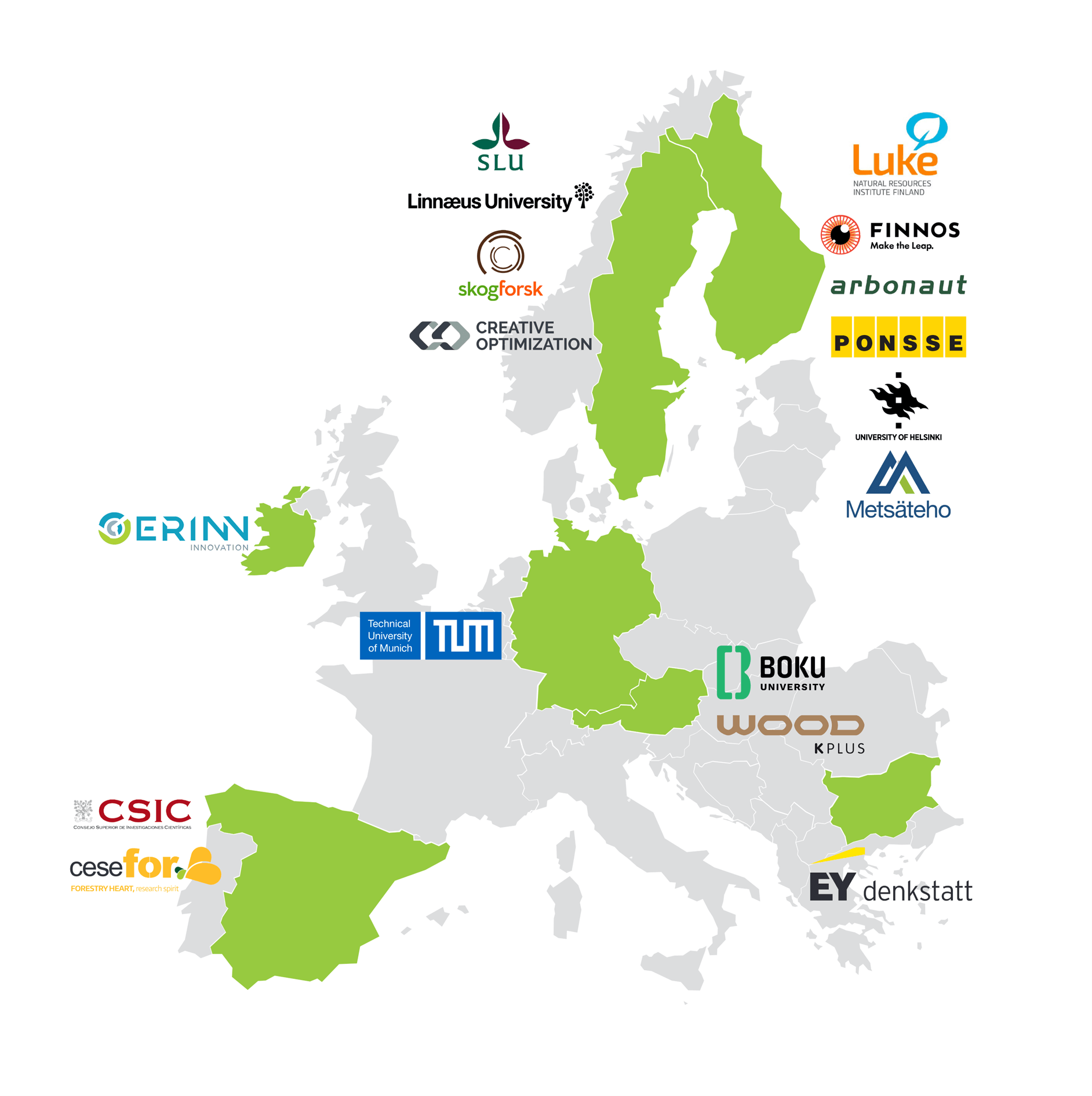
OptiForValue is supported by the Circular Bio-based Europe Joint Undertaking and its members and is led by Luke (Natural Resources Institute Finland). The consortium consists of a multi-actor, transdisciplinary team of 17 organizations from 7 European countries (Austria, Bulgaria, Finland, Germany, Ireland, Spain, Sweden). The project also includes four regional case studies in Sweden, Finland, Austria and Spain. OptiForValue is ongoing from September 2024-August 2028.
Creative Optimization in OptiForValue
Creative Optimization is involved as a contributing partner in several key areas of the project, and leads two tasks:
- Responsive Scheduling of Operations
Timely and well-informed decisions are essential for maximizing resource efficiency, and advanced decision support tools play a crucial role in making the planning process more effective. In this task, the scheduling of harvesting activities is optimized based on early warning indicators that affect site accessibility and wood quality. - Case Study Sweden: Value from Supply
By modeling future scenarios and analyzing the outcome from potential shifts in policy, climate impact, and market fluctuations, this task aims to compare how this affects value chain resilience and efficiency in the long term.
Project is in collaboration with:
The OptiForValue project is supported by the Circular Bio-based Europe Joint Undertaking (CBE JU) and its members under Grant Agreement N° 101157658. Funded by the European Union. Views and opinions expressed are however those of the author(s) only and do not necessarily reflect those of the European Union or CBE JU. Neither the European Union nor the CBE JU can be held responsible for them.

