

Optimizing multifunctional forest-based value chains with single tree information and application of digital technologies.
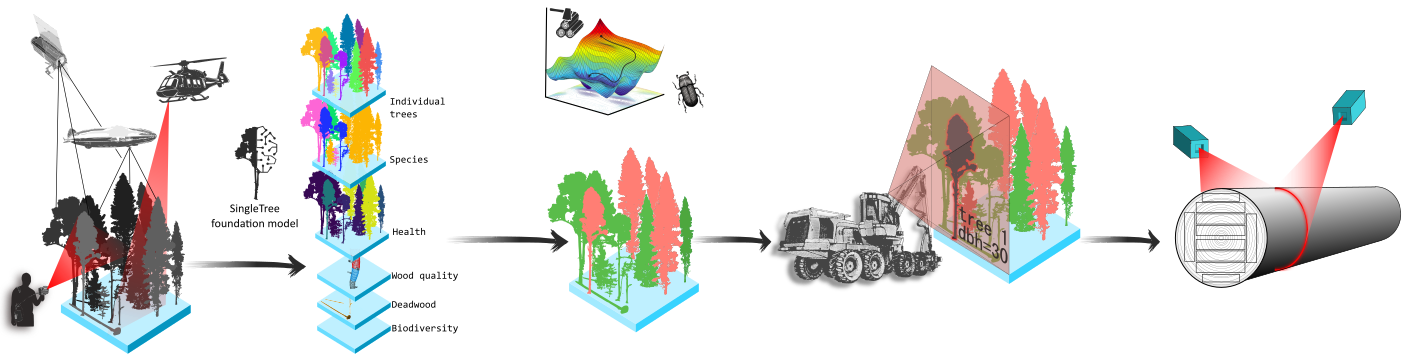
The EU Forest Strategy promotes sustainable forest management that strengthens the bioeconomy and enhances long-term forest resilience. At the same time, Europe’s forests face mounting risks, including storms, fires, drought, pests, and disease. Digital technologies provide powerful solutions to these challenges; deep learning models, geospatial analytics, and remote sensing offer detailed insights that provide high-resolution data for analytical tools and decision support systems – enabling precision forestry considering forest conditions, tree health and characteristics, as well as ecosystem dynamics.
Project description
The SingleTree project is dedicated to optimizing multifunctional forest-based value chains. By utilizing detailed single-tree information and applying advanced digital technologies, the aim is to enhance climate change adaptation, forest resilience, multifunctionality, and the cascading use of wood. Combined with modern machinery, integrated data systems, and improved value-chain traceability, digital innovation is key to making forestry more efficient, sustainable, and resilient. SingleTree seeks to demonstrate the advantages of adopting a more data-driven single tree approach, and provide examples of how it can be applied in different operational contexts.
The project is supported by the Circular Bio-based Europe Joint Undertaking and its members, and led by NIBIO (Norwegian Institute of Bioeconomy Research). The consortium includes 14 partners from 5 different countries, each with different areas of expertise. The project is ongoing from September 2024-August 2028.
Creative Optimization in SingleTree
As an SME-partner in the SingleTree project, Creative Optimization is involved in several work packages related to single tree-based forest management, bucking optimization and product-market logistics.
- Digitally enabled operations
In this work package, Creative Optimization leads the creation of individual tree bucking instructions that integrate real-time wood quality information, sensor data and market signals. The outcome will be compared to current “business as usual” practices, using bucking optimization models and data from harvest operations. The goal is to quantify how adaptive instructions at tree level can increase value creation along the forest value chain. - Wood traceability and quality for increased value creation
Creative Optimization will here evaluate how wood quality models, market constraints, pricing, processing, and conversion alternatives influence the economic outcome at single-tree level. By optimally allocating logs to their best end-use, different processing strategies will be compared – from fixed conversion to optimized bucking and combined value-optimized sawing/bucking. These analyses will determine how pre-harvest forest information can increase added value and support predictive decision making. - Connected Value Chains
This work package includes three “Living Lab Value Chains”: one in Sweden, another in Spain and a third in Switzerland, where concepts developed in the project are applied. Creative Optimization serves as a partner in all living labs, contributing expertise and tools to test and validate project outcome.





Funded by the European Union. Views and opinions expressed are however those of the author(s) only and do not necessarily reflect those of the European Union or CBE JU. Neither the European Union nor the CBE JU can be held responsible for them. Grant agreement N° 101157488.

